Multistakeholder Approaches to Participation in AI Governance (MAP-AI) Solicits Applications for Global AI Policy Working Groups



No Record Found.

Multistakeholder Approaches to Participation in AI Governance (MAP-AI) Solicits Applications for Global AI Policy Working Groups
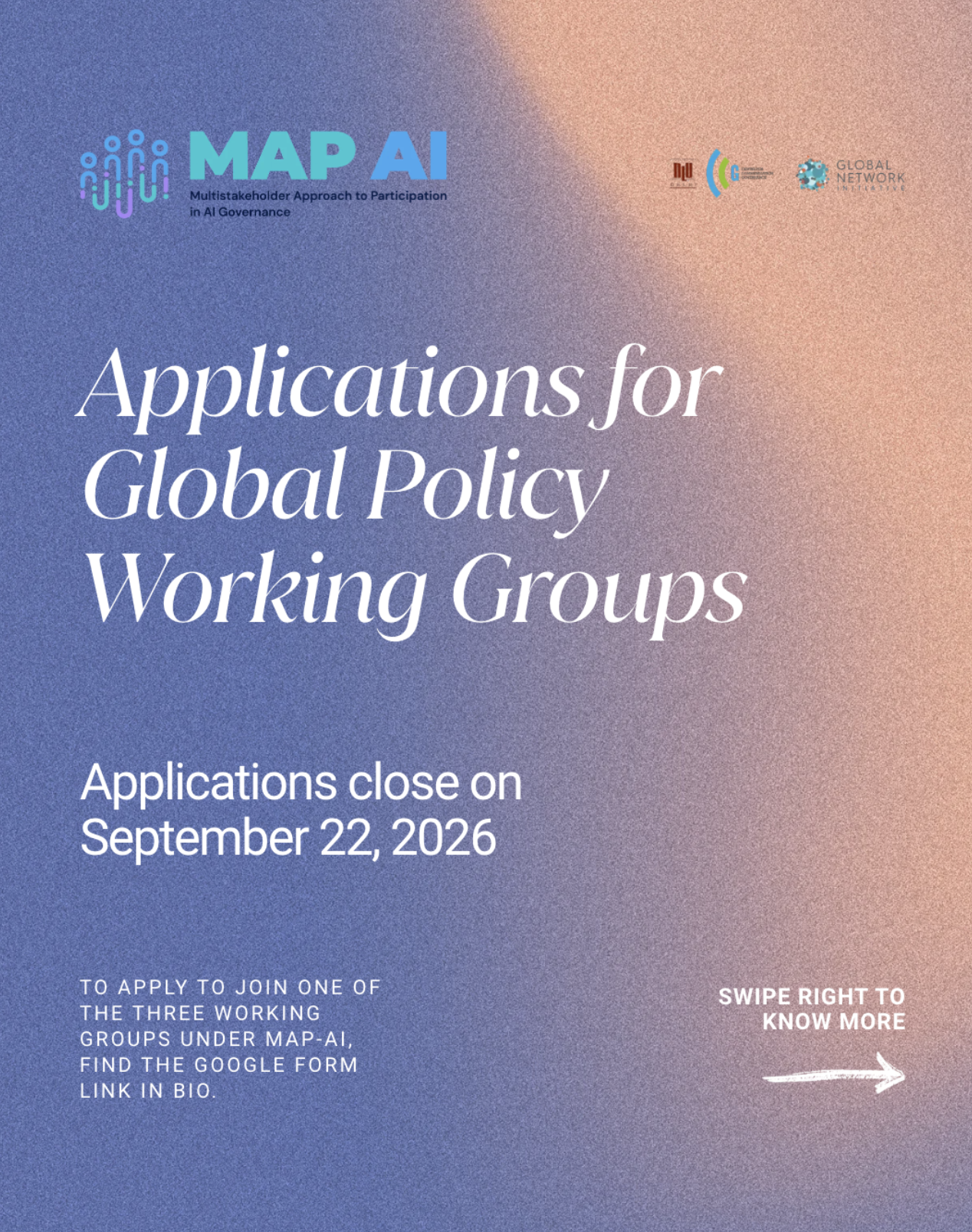
The Multistakeholder Approaches to Participation in AI Governance (MAP-AI) Project is excited to announce the launch of three Global AI Policy Working Groups organized around the pillars of Safe & Trusted AI, Global AI Governance, and Context-Driven Infrastructure. MAP-AI is actively seeking expressions of interest from actors across stakeholder groups shaping concrete AI policy proposals that address key human rights risks and opportunities associated with AI to participate in these Working Groups.
In 2025, the Centre for Communication Governance at the National Law University Delhi (CCG) and the Global Network Initiative (GNI) launched MAP-AI to facilitate civil society (CSO) participation and highlight Global Majority perspectives and the value of multistakeholder and rights-based approaches in AI governance at the India AI Impact Summit.
The next phase of the project aims to advance a bottom-up, substantive, pragmatic, rights-based approach to AI governance. This includes launching three Working Groups to develop global policy proposals for AI governance informed by and grounded in regional priorities from Latin America, Africa, and Asia. MAP-AI is launching these three Working Groups to ensure that credible perspectives from underrepresented regions, particularly from the Global Majority, shape global discourse and AI governance across critical policy moments.
About the Working Groups
The three Working Groups covering Safe & Trusted AI, Global AI Governance, and Context-Driven Infrastructure aim to develop concrete policy proposals to feed into the United Nations Dialogue on Artificial Intelligence and Global Governance (UNGDAI) in May 2027 and the Geneva AI Summit in June 2027. The multistakeholder Working Groups will operate on a volunteer basis and will hold virtual meetings monthly from October 2026 through June 2027. Working Groups will be co-led by two leading global experts or organizations on the topic and include participants from government, industry, civil society, international bodies, and academia. The Working Groups will collaborate through monthly meetings and asynchronous online work to develop policy proposals. More details on the thematic focus of each working group are available below. For a detailed description of the three pillars, please read this blog.
Policy proposals developed by the Working Groups will be underpinned by the cross-cutting themes of human rights; gender and child rights and Global Majority leadership and the role of middle powers.
Safe & Trusted AI
This Working Group will focus on developing policy proposals related to safe and trusted AI, including on topics such as best practices for AI safety institutes, evaluations & assessments, cybersecurity and incident reporting. Policy proposals could contextualize risk by defining bottom-up understandings of “unacceptable risk and harm,” identify necessary components for effective assessments/verification (e.g., shared infrastructure, processes for developing relevant methodologies, accreditation mechanisms), and explore collaborative response mechanisms to safety incidents.
Co-leads: Konstantinos Komaitis, Atlantic Council’s Democracy & Tech Initiative, and Urvashi Aneja, Digital Futures Lab/Global South Network for Trustworthy AI.
Global AI Governance
This Working Group will focus on AI governance, regulatory frameworks, and corporate accountability. Policy proposals could focus on defining redlines and thresholds, liability and accountability, procurement, transparency mechanisms and governance frameworks for the private sector, and operationalizing existing national level laws governing AI.
Co-leads: Jaqueline Pigatto, Data Privacy Brasil, and Maria Paz Canales, Global Partners Digital.
Context-Driven Infrastructure
This Working Group will focus on prioritizing regional capacity and access. Policy proposals could define best practices for shared resources and infrastructure, open source and small/local AI, digital public infrastructure, data governance, operationalizing context and culture into multilingual AI, participatory processes for AI development, and mitigating environmental impacts.
Co-leads: Pria Chetty, Research ICT Africa, and Aliya Bhatia, Center for Democracy and Technology.
Who should apply?
MAP-AI welcomes applications from both individuals and organizations from civil society, academia, government, industry, the technical community, media, international organizations, standards development organizations, or another field. Applicants do not need to have extensive experience engaging in multilateral fora, but they should be conducting work related to the topic of the Working Group they are applying to join.
Application Form
To apply to join one of the Working Groups, please fill out this Google Form. The deadline for applications is September 29, 2026.
The MAP-AI team and working group co-leads will assess the applications based on applicants’ demonstrated experience engaging with the topics covered by the Working Groups, while also trying to ensure that the groups have balanced gender, geographical, and stakeholder representation.
Please feel free to reach out to gbaker[at]globalnetworkinitiative.org if you have any questions about the Working Groups.
Important Details
Map AI


